Mesh Size vs Micron Size: Technical Whitepaper for Irrigation & Water Filtration Trades


Why Mesh vs Micron Sparks Debate
Ask ten people to define mesh and micron and you will hear twelve answers. Some contractors use the terms as if they are interchangeable; others insist that “100 mesh” and “100 micron” mean the same thing. They do not. Mesh is a count of openings in a woven screen. Micron is a unit of length. Because wire diameter, weave style, and media type all change how a filter actually behaves, the same job can be described in two very different ways, leading to confusion on job quotes, submittals, and change orders.
Purpose of This Whitepaper
This whitepaper settles the mesh‑versus‑micron debate for the trades. It provides clear, field‑tested explanations, simple rules of thumb, and realistic examples so you can specify, install, and maintain the right filtration for irrigation systems, well water, city hookups, golf courses, and sports complexes. By the end, you will know when to use mesh, when to use microns, how to convert between them, and how to avoid costly pressure‑drop and clogging issues.
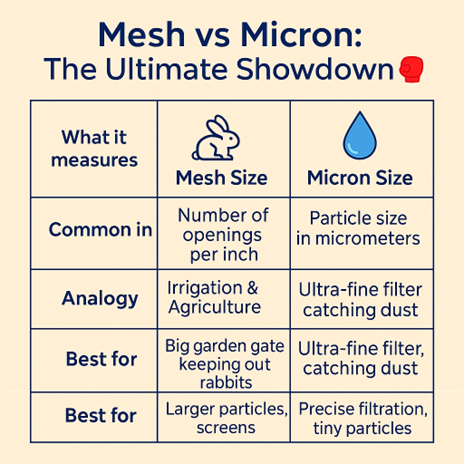
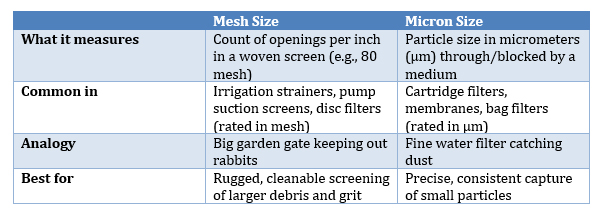
Quick Visual Comparison
Use this side‑by‑side to align stakeholders on terminology before specifying equipment:
Definitions & Useful Math
- Mesh (M): number of openings per linear inch in a woven screen. Higher M ⇒ smaller openings.
- Wire diameter (d): thickness of the screen wire. It reduces the open area and the clear opening.
- Clear opening (a): for square weave screens: a ≈ (1/M) − d (inches). Convert to micrometers by ×25,400.
- Percent Open Area (POA): POA ≈ (a / (a + d))² × 100 for square weave. Higher POA → lower pressure drop.
- Micron rating (μm): nominal ratings capture a stated fraction; absolute ratings typically ≥99% at the rated size.
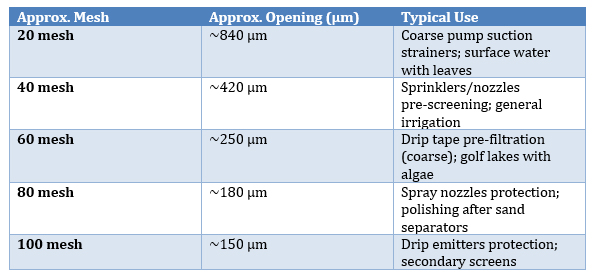
Field Conversions (Approximate)
Exact conversion requires wire diameter. These pairs are commonly used in irrigation as ballpark values:
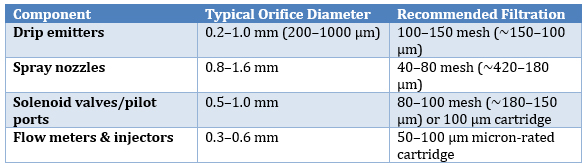
Protecting Orifices: Match Filter to the Smallest Opening
Rule of thumb: choose filter opening ≤ 1/10 of the smallest downstream orifice diameter:
Pressure Drop (ΔP) & Sizing Considerations
Aim for clean ΔP ≤ 1–2 psi across screens and ≤ 2–3 psi across cartridges at design flow. Trigger cleaning/changeout at ΔP = 5–7 psi.
ΔP rises roughly with velocity² through the media. If ΔP is high: upsize the housing, increase screen area, lower flow per element, or stage filtration.
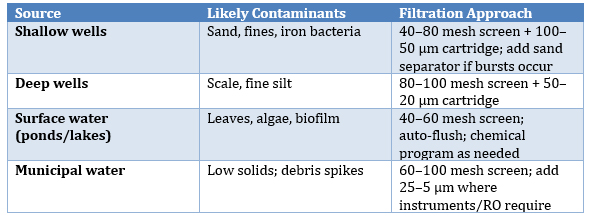
Contaminant Profiles by Source
Staged Filtration Examples
Example A – 18‑hole Golf Course Pump Station (3,000 gpm):
• Stage 1: automatic self‑cleaning screens, 40 mesh.
• Stage 2: disc filter banks 100 mesh (~150 μm).
• Backflush at 6 psi ΔP or 30 minutes; clean ΔP ≤ 2 psi per stage.
Example B – Sports Complex Drip Irrigation (120 gpm zone):
• Stage 1: Y‑strainer 80 mesh.
• Stage 2: 100 μm cartridge manifolds; changeout at 7 psi ΔP or 3 months.
• Flush ports at low points to purge fines.
Example C – Well Water Nursery (60 gpm):
• Stage 1: hydrocyclone sand separator (≥98% removal >100 μm).
• Stage 2: 60 mesh screen.
• Stage 3: 50 μm cartridge for fine mist nozzles.
Materials, Chemistry & Durability
304/316 stainless for strength and temperature (use 316 for chlorides); polymer housings for corrosion resistance; brass/bronze for municipal tie‑ins (watch dezincification). Verify seal compatibility with chlorination/acid cleaning if used.